Thirteen Deaf people in Pakistan telling the stories of their own lives

Author
Zoha Fatima Syed
A Harvard medical student with a Stanford degree in psychology and neuroscience, who spent months listening to Deaf people in Pakistan tell their own stories.
The book

Stories Unheard: The Deaf of Pakistan
Pakistan is home to millions of Deaf people, and to almost no written record of what their lives are actually like.
Stories Unheard follows Deaf people and families through the quiet, constant work of being understood – in a classroom, at a wedding, behind a shop counter, at the dinner table where no one else signs. It is a book about the distance between silence and absence, and about everything that gets built in that distance: language, stubbornness, love, refusal.
These are not stories about deafness. They are stories about the world Deaf people have made inside one that wasn't built for them.

Look Inside
A few pages from the book, so you can see how it reads before you buy.
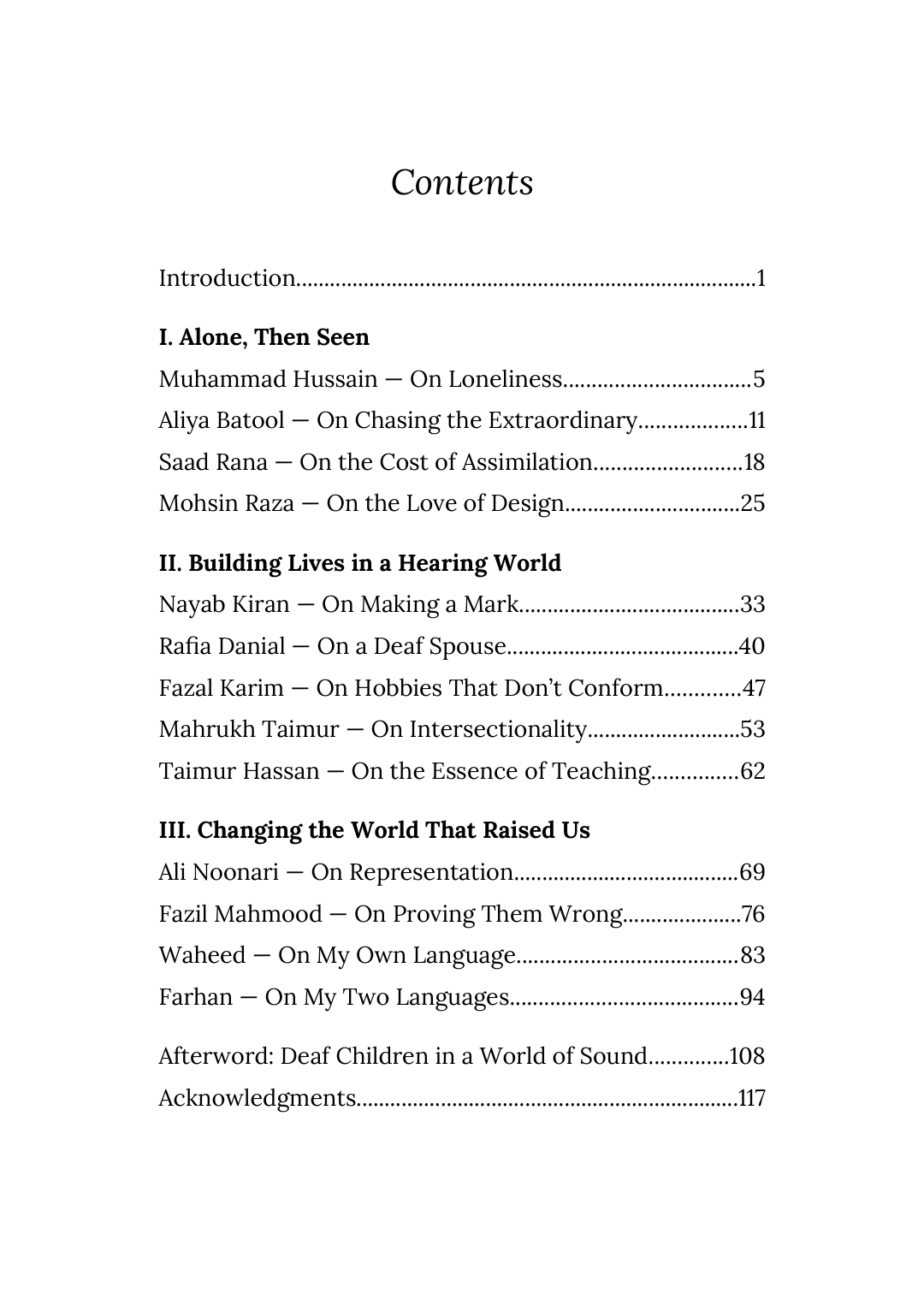
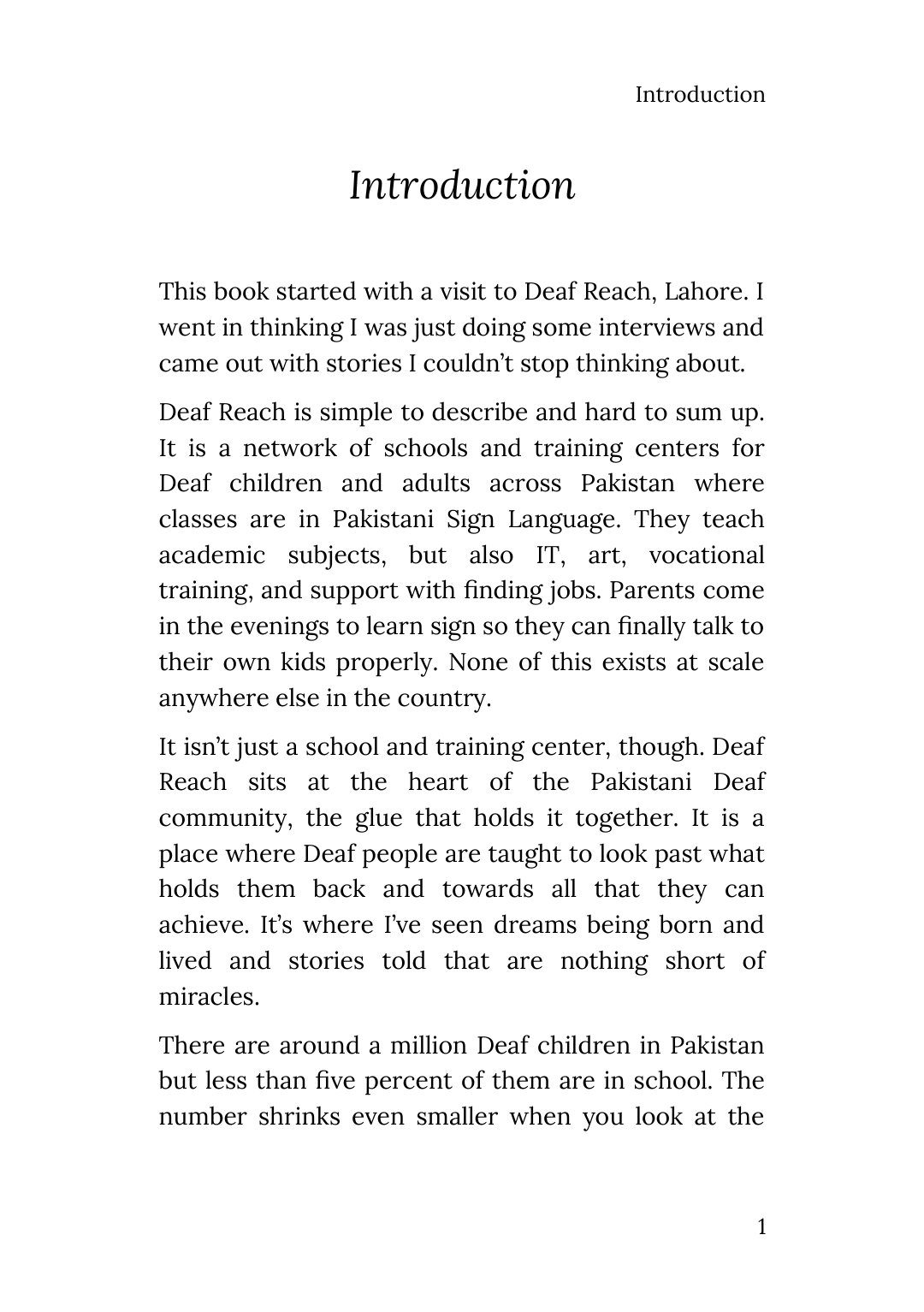
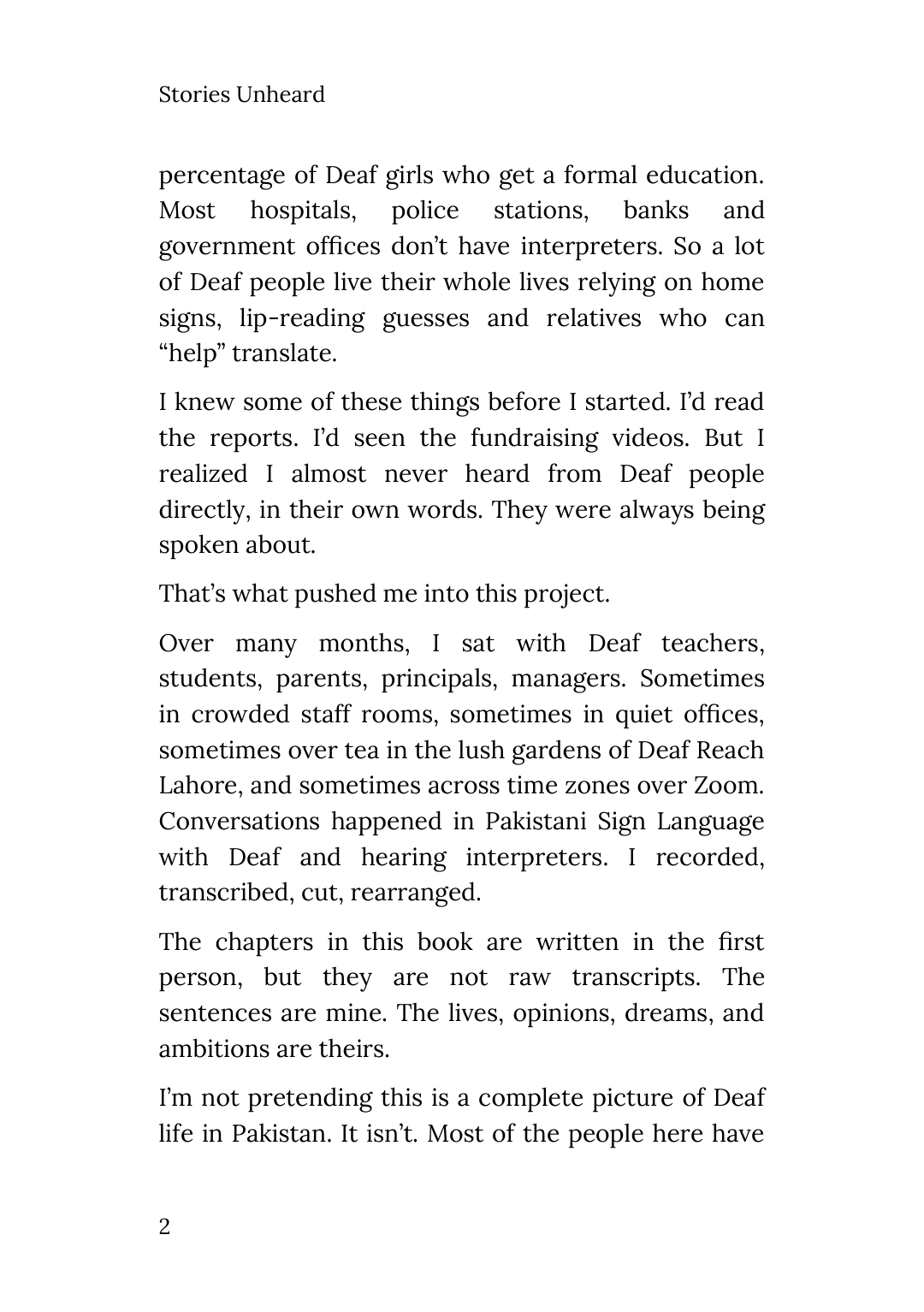
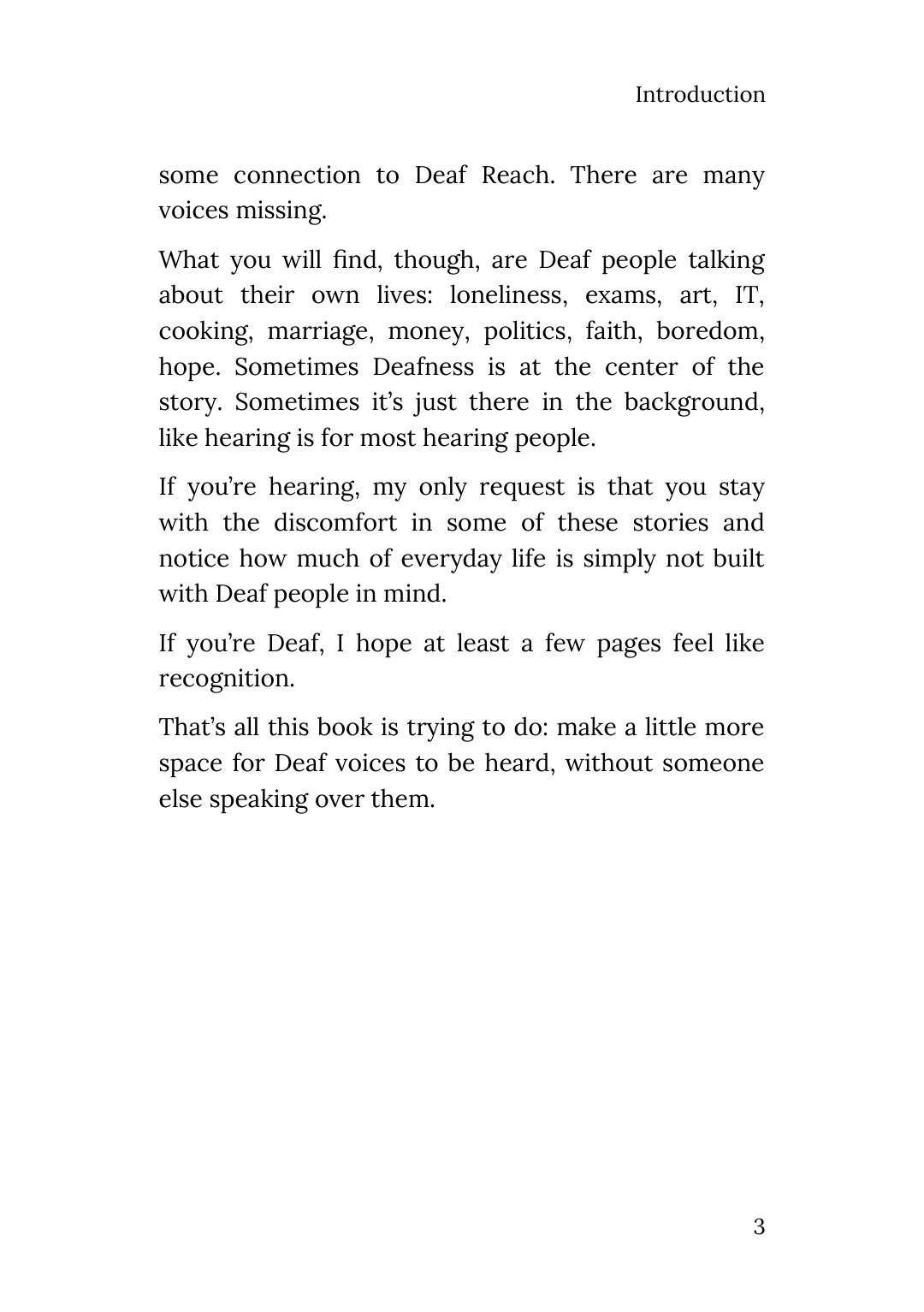
1 / 5
Swipe, tap or use your arrow keys
What this book is about.
Growing up Deaf in a hearing family, where parents often never learn to sign
School, work, marriage and hope, and the everyday work of being understood
A Deaf chef cooking his first meal for two hundred and fifty people at Deaf Reach
An afterword on why fewer than five percent of Pakistan’s million Deaf children are in school
About the Author
Zoha Fatima Syed is a medical student and writer whose work sits at the intersection of medicine, language, and human connection. She holds a bachelors in Psychology with a concentration in Neuroscience from Stanford University and is currently a medical student at Harvard Medical School, with plans to pursue a career in otolaryngology and head and neck surgery, with a long-standing commitment to working with Deaf populations. Stories Unheard grew out of her earlier work with Deaf Reach in Pakistan, where she first encountered the lives and voices this book seeks to honor. She currently lives and works in the Boston area.
Excerpts
Back in Swat, I realized I had no true connection to my family anymore, and it was too late to start developing one. They had their own lives, centered around the ability to hear and speak. Did I blame them for not learning Sign Language? Not really. Where else would they use it anyway? Dinner table conversations would happen. I could see them happen. I just wouldn’t know what was being said. My mother would do the infamous food sign towards the end, asking me if I wanted more. I would shake my head to politely decline and that would be the extent of my contribution.
My favorite part of the day is when the two of us come back from our day jobs at Deaf Reach around 3pm. He doesn’t leave until 5 for his evening shift so those two hours where it’s just the two of us are pure bliss. We drink tea. I usually make a snack to go along with the tea. Sometimes we talk about how our days went and what we’re looking forward to. I really can talk to him about anything. Other times we’re quiet, just enjoying each other’s presence. I always wish for those two hours to somehow stretch into infinity but as soon as the clock strikes 5, like Cinderella, he gets up to leave and I’m left waiting till late at night.
Whenever a new batch comes in, the first thing I do is pick up a marker and write my introduction on the whiteboard:
My name is Waheed. I am Deaf.
If you want to talk to me, you can write.
Or you can use signs.
They usually stare at me for a bit. I’m used to that.
Then I write three words they understand perfectly: Open your scrapbooks.
That’s the real start of our relationship.
I draw something on the board – a flower, a house, maybe a simple landscape. They copy it into their scrapbooks. As they draw, I walk slowly between the rows, watching each page. If someone is struggling, I don’t shout their name. I kneel down next to them, take the pencil gently, and show the line on their own paper.
Art doesn’t need a language. Through art, I can stand in front of eighty hearing children and just be their teacher. Not a “special case.” Not someone who needs pity. Just Sir.
Discover more authors published with us.

Sakina Fahad
View authorA young author and health advocate, writing for children about growing up in language they can actually use.

Salman Ahmad Bhutta
View authorPhysicist and writer blending science, creativity, and outreach, author of “Some Unstitched Words,” a reflective collection of philosophical and scientific thoughts.

Sarah Ahmad
View authorA poet, yogi and dreamer shaped by two cities — Karachi, where she was raised, and Istanbul, where she continues to grow.
Could your book be next?
Every author here began by sending us their manuscript. Register as an author and take your first step.
Register as an author